



Table of Contents
- Why Retro Ski Fashion Still Turns Heads on the Slopes
- The 5 Essential Items for Retro Ski Fashion at a Glance
- 1. The One-Piece Ski Suit
- 2. The Woollen Après-Ski Coat
- 3. Retro Ski Apparel Accessories That Finish the Look
- 4. Kangaroo Jumpers for a Playful Retro Layer
- 5. Sustainable Ski Fashion: Why Vintage Wins
- Conclusion
- Frequently Asked Questions
Last Updated: September 17, 2026
Why Retro Ski Fashion Still Turns Heads on the Slopes
Retro ski fashion is the deliberate revival of mid-century alpine clothing: bold colour-blocking, fitted one-piece suits, woollen après-ski coats and playful knitwear, worn on and off the mountain. At I Dream of Snow, we've watched that revival move from novelty to genuine style choice, and the reason is simple. Vintage pieces were built to be seen, at a time when ski resorts were as much a social stage as a sporting venue.
That's the throughline of this guide. Most modern ski wear is engineered to disappear into the snow. Retro ski fashion does the opposite, and that's exactly why it still works. Below, we'll show you the five essential items that make the look, how to wear each one, and where to find pieces worth keeping.
The 5 Essential Items for Retro Ski Fashion at a Glance
The five essentials for retro ski fashion are a one-piece ski suit, a woollen après-ski coat, retro accessories, a playful knit layer and a sustainable vintage sourcing habit. Each plays a distinct role: the suit anchors the silhouette, the coat carries you off the slopes, and the accessories do the storytelling.

Item |
Role in the Look |
Best For |
Where It Shines |
|---|---|---|---|
One-piece ski suit |
Anchors the silhouette |
On-slope days |
Bold colour and clean lines |
Woollen après-ski coat |
Off-slope statement |
Village and lodge |
Wool texture and tailoring |
Retro accessories |
Finishes the outfit |
Everywhere |
Hats, goggles, belts |
Kangaroo jumper |
Playful mid-layer |
Cool days and lodges |
Knit colour and charm |
Vintage sourcing |
Keeps it sustainable |
Long-term collecting |
One-of-a-kind pieces |
1. The One-Piece Ski Suit
The one-piece ski suit is the single item that defines retro ski fashion. Nothing else communicates the era as immediately, and nothing else solves the outfit problem as completely: one garment, one silhouette, one decision in the morning.
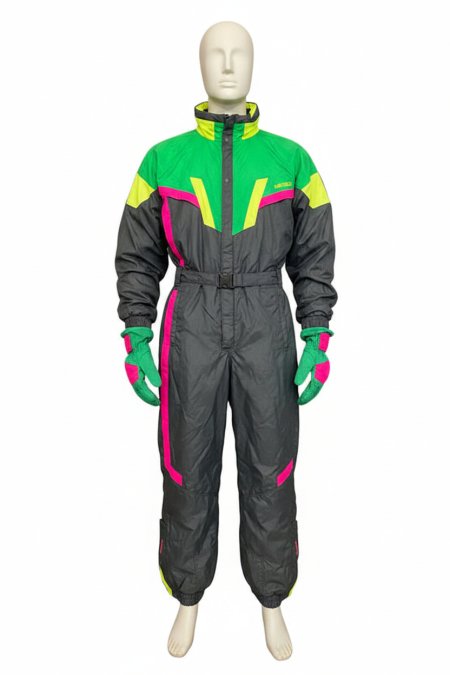
Vintage Nevica Black Green Yellow Pink 1-Piece Ski Suit with Matching Gloves
Why a One-Piece Suit Defines the Look
A one-piece suit creates an unbroken vertical line, which is why the vintage versions photographed so well and why they still do. The detailing does the rest: gathered waists, contrast panels, epaulettes, metal belt buckles, stirrup cuffs. Our Vintage Sport & Fashion violet and purple patterned one-piece ski suit shows the formula clearly, with a gathered waist and a triangular fold panel across the chest covering the zip.
The practical case is just as strong. A common mistake is assuming vintage suits are fragile. In practice, many are wool-rich and densely woven, and several Bogner designs even unzip at the waist to convert into a two-piece, which is genuinely useful when the afternoon warms up.
How to Style It
Keep everything else quiet. A one-piece is already the loudest thing you're wearing, so let it lead.
- Choose one accent colour from the suit and repeat it in your hat or goggles
- Add a slim belt if the suit has belt loops, or skip it if the cut is already fitted
- Wear flat, simple boots in the village; the suit does the work
- Skip the modern oversized puffer over the top, it flattens the silhouette
2. The Woollen Après-Ski Coat
A woollen après-ski coat is the piece that carries retro ski fashion off the mountain and into the village. Wool holds structure in a way synthetic shells never do, so it reads as tailored rather than technical, which is precisely the point.
The 1960s Olympic uniform coats are the benchmark here. Our 1960s Teller Austrian Winter Olympic red wool coat was made by the official outfitters to the Austrian ski team, in wool with black piping and a printed cotton lining. The green version carries the same detailing. Both fit like a current AUS size 10 to 12.

Style it over a fine knit with straight-leg trousers, or over your ski base layers for the walk back from the lifts. What most guides miss is that these coats are genuinely warm, not costume. Wool is one of the oldest performance fabrics there is.
3. Retro Ski Apparel Accessories That Finish the Look
Retro ski apparel accessories are what separate a costume from an outfit. The suit and coat set the tone; the accessories tell the story, and they're also the cheapest way into the look if you're testing whether it suits you.
The essentials:
- A knitted headband or bobble hat in a colour drawn from your suit
- Round or shield-style sunglasses rather than modern wraparound goggles
- A slim leather belt, or the original metal buckle belt if the suit came with one
- Leather gloves rather than technical mittens
- A simple knit scarf for the village, kept short so it doesn't trail
Two rules keep this from tipping into fancy dress. First, limit yourself to two accent colours across the whole outfit. Second, make sure everything actually fits, because retro accessories look deliberate when they fit and borrowed when they don't.
4. Kangaroo Jumpers for a Playful Retro Layer
The styling logic is straightforward. A kangaroo jumper is bulky by design, so it works best under a coat with room in the shoulders, and best over a fitted base layer rather than another loose knit. Choose one colour from your suit's palette and let the jumper carry it.
Where it falls short: a heavy knit isn't a substitute for a proper insulating mid-layer on a genuinely cold day. Treat it as a lodge and village piece, or a layer for milder spring skiing, and it will earn its place in your rotation.
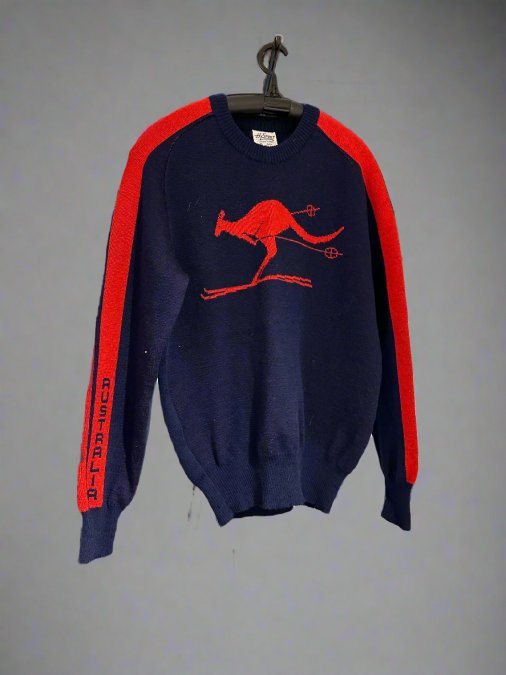
Vintage HySport Navy Blue Skiing Kangaroo Australia Jumper
5. Sustainable Ski Fashion: Why Vintage Wins
Sustainable ski fashion starts with a simple question: what happens to the gear already made? Every vintage piece that stays in circulation is one fewer new garment manufactured, and ski wear is a category where the vintage option is often the better-made one.
This is where I Dream of Snow's approach matters. The business is built around reuse, repair and resale rather than volume, and the catalogue reflects it. Marks are disclosed honestly, from a faded panel to a seam coming apart in a lambswool hood, because a repaired garment that lasts another decade beats a new one that doesn't.
If you're coming from buying new each season, expect an adjustment. You won't find every size in every colour. You will find pieces with real provenance, like a suit made in West Germany or a coat worn by an Olympic team, and those are the pieces people ask about on the chairlift.

Conclusion
The hardest part of building a retro ski wardrobe isn't finding bold pieces, it's finding ones that fit properly and are honestly described. That's the gap I Dream of Snow was built to close, with a curated collection of vintage ski apparel and equipment, transparent condition notes, a 14-day exchange window, and a personalised sourcing service for specific pieces you're chasing. Start with a one-piece suit and a woollen coat, then layer in the accessories. Shop vintage at I Dream of Snow and build a look that outlasts the season.
Frequently Asked Questions
What defines retro ski fashion?
Retro ski fashion is defined by bold patterns, one-piece silhouettes, and the colours of the 1960s through 1980s. Think geometric prints, purple and orange tones, woollen fabrics, and functional details like stirrup trousers and belt buckles. It is about capturing the spirit of ski culture from a bygone era while still being wearable today. The look draws on the styles worn on European and Australian slopes decades ago, now revived by skiers who want something distinctive rather than mass-produced.
How can I style vintage ski gear for a modern look?
Balance one bold vintage piece with simpler modern items. A patterned one-piece suit works well with plain boots and minimal accessories, while a woollen après-ski coat looks sharp over jeans and a polo neck off the mountain. Keep the rest of your outfit understated so the vintage piece stands out. Adding a modern bobble hat or contemporary goggles can also bridge the gap between eras without losing the retro feel.
Are vintage ski suits still warm and functional?
Many vintage ski suits were made from wool and nylon blends that hold warmth well, such as a 60% wool, 40% nylon construction. One-piece designs also eliminate gaps at the waist where cold air seeps in. That said, older fabrics may have faded or show wear, so check condition carefully before buying. A well-maintained vintage suit can perform on the slopes, particularly for spring skiing when lighter insulation is an advantage.
Where can I find authentic vintage ski apparel?
Authentic vintage ski apparel is best found through specialist sellers who source and verify pieces directly. Look for detailed listings that name the original brand, country of manufacture, and any marks or wear. I Dream of Snow offers a curated collection of vintage ski apparel and equipment, with sizing notes that help you work out fit before buying. A personalised sourcing service can also track down specific pieces if you know what you are after.
Why is sustainable vintage ski fashion popular?
Sustainable ski fashion is popular because buying vintage keeps quality clothing in circulation rather than sending it to landfill. Each pre-owned suit or coat avoids the resources needed to produce something new. Many buyers also value the uniqueness: no one else on the mountain will have the same jacket. Repair and reuse practices extend an item's life further, making vintage a practical choice for anyone who wants to reduce waste while building a distinctive wardrobe.