



Last Updated: November 18, 2026
Quick Summary
Vintage apres-ski coats are secondhand ski or resort coats made between the 1950s and 1980s, and buying one in 2026 makes sense for their genuine wool and down construction, distinctive look and sustainability. Inspect shoulder seams, lining, zips and moth damage before buying, and always size from measurements rather than the label.
- Check shoulder seams first, as they carry the most stress of any part of a ski coat.
- Ask sellers for photos of the back, underarms, lining, label and zip pull.
- Layer a merino base and fine wool jumper underneath, never anything bulky.
- A 1960s size 12 is commonly closer to a modern size 10.
- Store coats in breathable cotton bags with cedar blocks, never plastic.
Table of Contents
- Why Vintage Après-Ski Coats Are Worth It in 2026
- What to Look for When Buying a Vintage Ski Coat: A Practical Inspection Checklist
- How to Layer Vintage Ski Jackets for Warmth
- Vintage Ski Coat Sizing: Getting the Fit Right Across Eras
- Vintage Ski Jacket Materials: Wool, Down, Fleece and Shearling
- How to Care for Vintage Ski Clothing: Cleaning, Repair and Storage
- Shop Vintage Coats at I Dream of Snow
- Frequently Asked Questions
Why Vintage Après-Ski Coats Are Worth It in 2026
Vintage après-ski coats are secondhand ski or resort coats, typically made between the 1950s and 1980s, worn off the slopes for warmth and style.
The appeal is not nostalgia for its own sake. It is the quality of the cloth, the weight of the fastenings, and the fact that a coat made sixty years ago was designed to be repaired, not replaced.
Here is what most guides get wrong: they treat vintage ski clothing as costume. It is not. A good vintage ski coat is a working winter garment first and a statement piece second.
sustainability guidance on textile reuse and repair
What to Look for When Buying a Vintage Ski Coat: A Practical Inspection Checklist
Start with the seams, not the colour. A beautiful coat with a failing shoulder seam is a repair bill, and shoulder seams carry the most stress of any part of a ski coat. The inspection below is the sequence you should follow in person or request from a seller online.
Structural checks
- Shoulder seams: turn the coat inside out and check for pulled threads, re-stitching or shine where the wool has worn thin. Re-stitching is not automatically a fault, a clean repair by a tailor is often stronger than the original seam, but loose, puckered hand-stitching signals a rushed fix.
- Armhole and side seams: these take the second-most strain. Run a finger along the inside of each seam; any gap you can feel will widen with wear.
- Lining: lift it away from the shell. Printed cotton linings from the 1960s often split at the underarm, and a clean, intact lining is a good sign the coat was stored well. A lining that has been replaced is not a dealbreaker, but ask why.
- Fastenings: zip the coat fully, then unzip it. Vintage metal zips should run smoothly; sticky teeth usually mean grit, not failure, but a skipped tooth is permanent. Check that buttons are original and that the buttonholes are not stretched, a stretched buttonhole tells you the coat was worn done up over bulky layers.
- Underarms and collar: these are where sweat and friction show first. Grey or brittle wool here cannot be reversed, and a collar that has worn through at the fold is expensive to rebuild invisibly.
- Moth damage: hold the coat up to a window. Small holes cluster near hems and cuffs, and fresh holes have clean edges while old ones are felted and grey. Check inside the pockets and under the collar, where larvae prefer to feed.
- Fur trim: check for bald patches and a musty smell, which signals damp storage.
Authenticity and era clues
Labels are the fastest way to date a coat, but they are also the easiest thing to fake or replace. Cross-check the label against the construction:
- Brand and outfitter labels: original brand labels,
- Zip maker: the zip pull is often a better dating tool than the label. Metal zips from the 1960s and 1970s carry maker marks that changed over time, and a modern plastic zip on a coat sold as 1960s is a red flag.
- Construction details: period coats typically use bound seams, cotton tape at stress points and metal hardware. Overlocked seams throughout, synthetic interfacing and plastic buttons point to a later retro piece rather than a period garment.
- Materials: wool, down and shearling were the dominant insulations of the era. A coat described as 1970s but made from a modern synthetic shell is almost certainly a reproduction.
What to ask a seller
A seller who photographs only the front of a coat is usually hiding the back, the underarms or the lining. Ask for those three photos specifically, plus a close-up of the label, the zip pull and any marks. Ask directly: has it been repaired, has it been cleaned, and how has it been stored? A seller who answers in detail is a better risk than one who answers vaguely, regardless of the coat.
Watch out: a coat that photographs beautifully but has no lining, label or zip photos is the most common source of disappointment in second-hand buying, request the missing images before you commit, every time.
How to Layer Vintage Ski Jackets for Warmth
The rule is simple: thin layers close to the body, thick wool on the outside, and nothing bulky under the arms. Vintage après-ski coats were cut for a jumper and a shirt, not a puffer, so adding too much underneath restricts movement.
Our recommended layering order for a cold day:
- Base layer: a merino or thermal top that sits close to the skin.
- Mid layer: a fine wool jumper or a light fleece, not a chunky knit.
- Shell: the vintage wool or down coat, zipped or buttoned to the collar.
- Accessories: a scarf and gloves do more for perceived warmth than an extra layer ever will.
For a deeper walkthrough of layering retro ski wear for real warmth, including how to handle a coat that fits closely across the shoulders, see our guide on how to layer vintage ski jackets for warmth.
Vintage Ski Coat Sizing: Getting the Fit Right Across Eras
Vintage sizing varies by decade, so the label is a starting point rather than an answer.
How sizing shifted by era
The pattern most vintage dealers work from is directional rather than exact, because sizing was never standardised across makers:
- 1950s and 1960s: garments were cut close and short, with narrow shoulders and a defined waist. A 1960s size 12 is commonly closer to a modern size 10, and sleeve lengths run short by current standards.
- 1970s: cuts loosened through the body but shoulders stayed relatively narrow. A 1970s label often sits one size below its modern equivalent.
- 1980s: the decade of oversized silhouettes. A 1980s label can sit anywhere between two modern sizes, and a coat marked small may fit like a modern medium.
Because of this, never assume a size number transfers between eras. Always size from measurements.
How to measure a coat
Lay the coat flat, buttoned or zipped, and measure:
- Chest: armpit to armpit across the front, then double it.
- Shoulder width: seam to seam across the back, from the top of one shoulder seam to the other.
- Sleeve length: from the shoulder seam to the cuff, following the outside of the sleeve.
- Length: from the base of the collar to the hem at the back.
Compare those numbers against a coat you already own that fits well, measured the same way.
Allowing room for layers
A vintage ski coat was cut for a jumper and a shirt, not a puffer, so the measurements need to leave room for what you will actually wear underneath.
Pay attention to shoulder seams in particular. The seam should sit at the edge of your shoulder, not past it. A coat that is slightly loose through the body can be belted; a coat with dropped shoulder seams cannot be fixed.
Watch out: a coat that measures correctly but has dropped shoulders will always look oversized, no matter how you style it, check the shoulder seam position before you fall for the chest measurement.
Vintage Ski Jacket Materials: Wool, Down, Fleece and Shearling
Wool is the backbone of vintage ski clothing. It insulates when damp, resists odour and holds its shape for decades, which is why so many Olympic uniform coats were cut from it. Down gives the most warmth for the least weight but loses performance once it is compressed or wet. Fleece is lighter and easier to clean but pills and mats with age. Shearling and fur trims add warmth at the collar and cuffs but need specialist care.
| Material | Warmth | Weather resistance | Care difficulty | Best for |
|---|---|---|---|---|
| Wool | High | Good when dry | Moderate | Structured coats, resort wear |
| Down | Very high | Poor when wet | Moderate | Very cold, dry conditions |
| Fleece | Moderate | Moderate | Easy | Mid layers, milder days |
| Shearling | High | Moderate | Specialist only | Statement collars and trims |
Best for: wool if you want one coat that works on and off the slope. Skip if: you need full water resistance, because no vintage wool coat provides it.
How to Care for Vintage Ski Clothing: Cleaning, Repair and Storage
Care begins with restraint. Spot-clean small marks with a damp cloth and mild detergent before you consider a full wash, and send structured wool or fur-trimmed coats to a specialist cleaner rather than risk shrinkage.
For storage, use a breathable cotton garment bag, never plastic, and add cedar blocks to deter moths. Store coats flat or on a broad wooden hanger to protect the shoulder line. Check them each season for damp and insect damage.
For the complete method, including repairs and long-term storage, read our complete guide to caring for vintage ski suits. For the broader case for buying secondhand ski wear at all, see why vintage ski clothing is worth buying.
Shop Vintage Coats at I Dream of Snow
Browse our curated vintage snow clothing collection, or start with a piece we are especially proud of: the 1960s Teller Austrian Winter Olympic red wool coat, an official Austrian Ski Team uniform coat in red wool with black piping and a printed cotton lining, which fits like a current size 10.
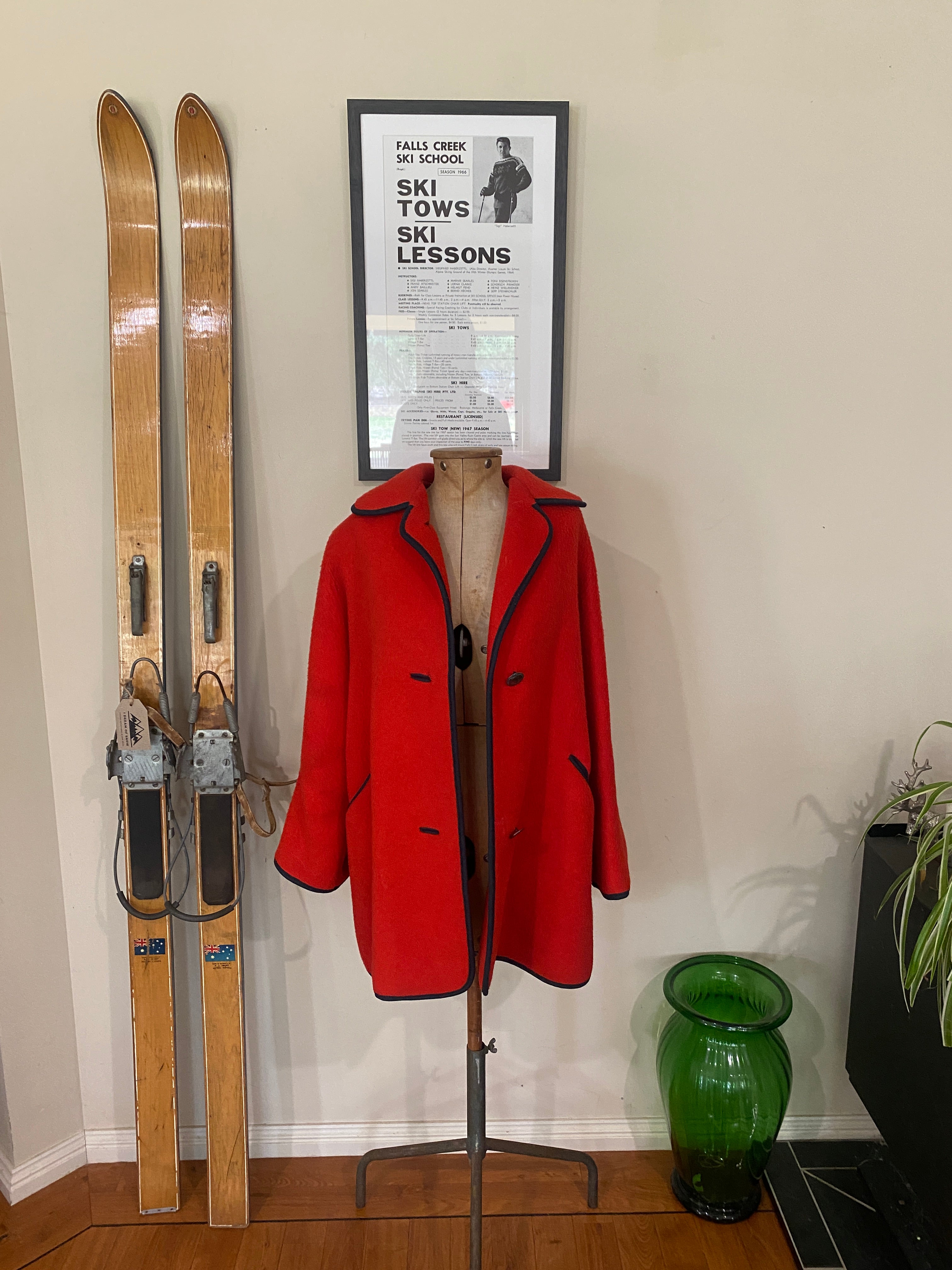
Exchanges are available within 14 days.
The hardest part of buying vintage is trusting what you cannot try on. We take that risk seriously: every coat is measured, inspected and described before it reaches you, with exchanges within 14 days if the fit misses. Get started with I Dream of Snow and find a coat built to outlast the trend.
Frequently Asked Questions
How can I tell whether a vintage ski coat is warm enough?
Check the fibre content on the label and the weight of the fabric in your hands. Wool coats like the 1960s Teller Austrian Winter Olympic styles are made from wool and lined inside with printed cotton. Down-filled pieces trap heat but lose loft if flattened. Look for a substantial lining, intact fastenings and no thin patches at the elbows or shoulders. For real cold, plan to layer a jumper and base layer underneath rather than relying on the coat alone.
How should a vintage ski jacket fit over layers?
You want room through the shoulders and chest to fit a base layer and a jumper without pulling across the back. Vintage ski coat sizing runs smaller than modern equivalents, so check the listed measurements against a coat you already own rather than trusting the label size. The 1960s Teller red wool coat, for example, has no size label but fits like a current AUS 10. Shoulder seams should sit at the edge of your shoulder, not past it.
Can vintage ski coats be worn for skiing today?
Vintage wool and fur-trimmed coats are best kept for resort wear, travel and off-slope outfits rather than active skiing. They were not built with modern waterproofing or breathability, so snow can soak through wool over a full day on the hill. Wear them for lunch stops, village walks and après-ski, and keep a technical shell for the slopes themselves. This also protects the coat from wear that shortens its life.
What is the difference between a ski jacket and an après-ski coat?
A ski jacket is built for on-slope wear, with waterproofing, breathability and sealed seams to handle snow and sweat. An après-ski coat is designed for off-slope wear: warmth, style and comfort for the village, lodge or travel. Vintage apres-ski coats lean heavily toward wool, fur trim and tailored cuts. Understanding this difference helps you choose the right piece and avoid expecting slope performance from a coat made for social wear.
